







In the world of shonen anime, a well-defined power system is the foundation of the action. While systems like Ki (Dragon Ball) and Chakra (Naruto) are iconic, the Nen from Hunter x Hunter (H x H) is almost universally cited by fans and critics as the most brilliant, complex, and satisfying system ever conceived.
Nen is based on the manipulation of aura (life energy) that flows from the body. Its complexity lies in the combination of unbreakable rules and the creative freedom it grants its users.
I. The Fundamentals of Nen (The Four Major Principles)
Before a user can develop a specific technique (Hatsu), they must master the four basic fundamentals:
- Ten (Envelop): Maintaining the aura around the body, preventing it from leaking. It serves as a basic defense and prevents energy depletion.
- Zetsu (Suppress): Stopping the flow of aura, hiding the user’s presence. It is useful for tracking and replenishing energy but leaves the body defenseless.
- Ren (Refine): Producing and releasing a greater volume of aura than Ten. It is used to temporarily increase strength and defense, preparing for combat.
- Hatsu (Release): The personal manifestation of Nen, creating a unique technique based on the user’s innate talent. It is the practical application of the ability.

II. The Six Categories of Hatsu
Every Nen user belongs to one of the six categories, determined by their personality. This classification is the engine of conflict and strategy in H x H, as each category has fixed strengths and weaknesses.
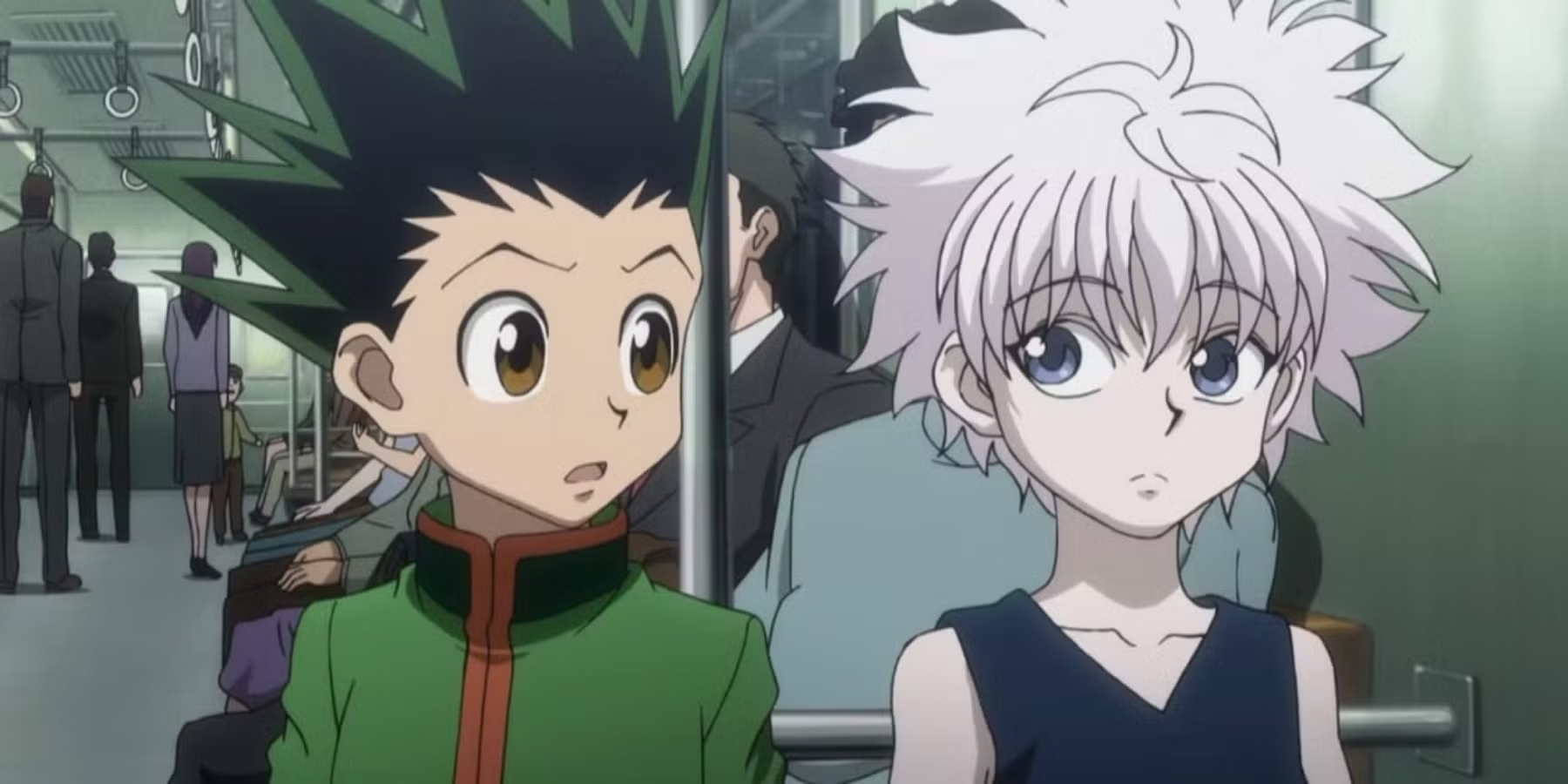
- Enhancement: Strengthens objects or the user’s body. (Gon Freecss)
- Personality: Simple and determined.
- Transmutation: Changes the properties of the aura to imitate something else (e.g., fire, electricity, rubber and gum). (Killua Zoldyck)
- Personality: Deceitful and whimsical.
- Emission: Allows the user to project their aura away from their body without it weakening. (Leorio Paradinight)
- Personality: Impatient and impulsive.
- Manipulation: Remotely controls objects, living beings, or even the aura itself. (Shalnark, Illumi Zoldyck)
- Personality: Logical and rule-oriented.
- Conjuration: Materializes a real physical object with aura (e.g., swords, chains). (Kurapika Kuruta)
- Personality: Nervous and serious.
- Specialization: Any Hatsu that does not fit into the other five categories. It often involves unique abilities (e.g., stealing other abilities). (Chrollo Lucilfer, Neon Nostrade)
- Personality: Charismatic and individualistic.

III. The Key to Perfection: Conditions and Limitations
The main reason why Nen is acclaimed is the introduction of Conditions, Vows, and Limitations. This rule allows users to exponentially increase the strength of their Hatsu in exchange for a proportional risk.
- The Principle of Restriction: If a user imposes a self-imposed restriction on their ability (e.g., “I will only use my chain against members of the Phantom Troupe”), the power of that ability drastically increases.
- The Risk of the Vow: If the user breaks the vow, they suffer a penalty proportional to the restriction (such as death or permanent loss of Nen).
- Narrative Relevance: This mechanism forces characters to be strategic, intelligent, and creative. Victory never depends on a simple power increase, but on a cunning application of limitations.
IV. Comparison with Other Systems
Nen stands out because it balances internal logic and creativity, something simpler systems often sacrifice.
| Power System | Primary Focus | Advantage over Nen | Disadvantage compared to Nen |
| Ki (Dragon Ball) | Quantity of pure energy. | It is more accessible and visually spectacular. | Lacking in rules and strategic creativity. |
| Chakra (Naruto) | Elemental nature and fixed techniques. | Allows for a solid foundation of ninja techniques. | Power progression becomes linear and depends on the quantity/variety of Jutsu. |
| Haki (One Piece) | Willpower and user type (Observation, Armament, Conqueror). | Direct integration with the concept of will. | Less diversity in the manifestation of personal abilities. |
Conclusion
Nen is acclaimed as the best power system because it is a philosophy. It is not just a set of rules for launching attacks; it is a structure that compels creativity. By basing abilities on personality and allowing self-imposed weaknesses to become strategic strengths, Nen ensures that every battle in Hunter x Hunter is an intellectual game of chess, not just a test of brute strength. It is a system that rewards the writer, the character, and the reader alike.






Hi there, the whole thing is going nicely here and ofcourse every one is sharing information, that’s
truly fine, keep up writing.
I really appreciate your kind words.
Howdy! I could have sworn I’ve been to this blog before but
after going through many of the posts I realized it’s new to
me. Regardless, I’m certainly pleased I discovered it and I’ll be
bookmarking it and checking back often!
In that case, welcome! I hope you find more content you enjoy, and if you have any suggestions, they are also accepted and appreciated.
Howdy! This blog post couldn’t be written much better!
Reading through this article reminds me of my previous roommate!
He continually kept talking about this. I will send this post
to him. Pretty sure he’ll have a great read. Thanks for sharing!
What a nice memory! We hope he also enjoys our blog, thank you for the comment and the recommendation, best regards
There is definately a great deal to find out about this issue.
I like all of the points you made.
What’s up to all, how is the whole thing, I think every one is getting more from this site, and
your views are good designed for new users.
Heya i am for the first time here. I came across this
board and I find It truly useful & it helped me out much.
I hope to give something back and aid others like
you helped me.